Introduction
Maintaining military discipline in complex environments is among the most difficult tasks in combat operations management. The experience of major armed forces like the U.S. military in Iraq and Afghanistan shows that discipline does not automatically flow from professionalism or technological superiority. In general, controlling any army becomes far harder when adversaries blend into civilian populations especially in settings marked by ethnic, religious, or sectarian diversity. Discipline also erodes when rules of engagement shift under the pressure of casualties, and when improvised explosive devices, ambushes, and concealment are used not only to degrade capabilities, but to exhaust nerves and morale first.
As warfare becomes increasingly digitized, the ubiquitous presence of cellphones and cameras coupled with the dominance of competing narratives amplifies the impact of any single incident and can generalize it across the entire military institution. A limited violation can therefore undermine a broad political objective by eroding trust, fueling counter-recruitment, and constraining political decision-making. This analogy underscores a central point: discipline is not an idealistic virtue, but a prerequisite for strategic success in wars where the adversary competes for the population as much as it competes for territory.
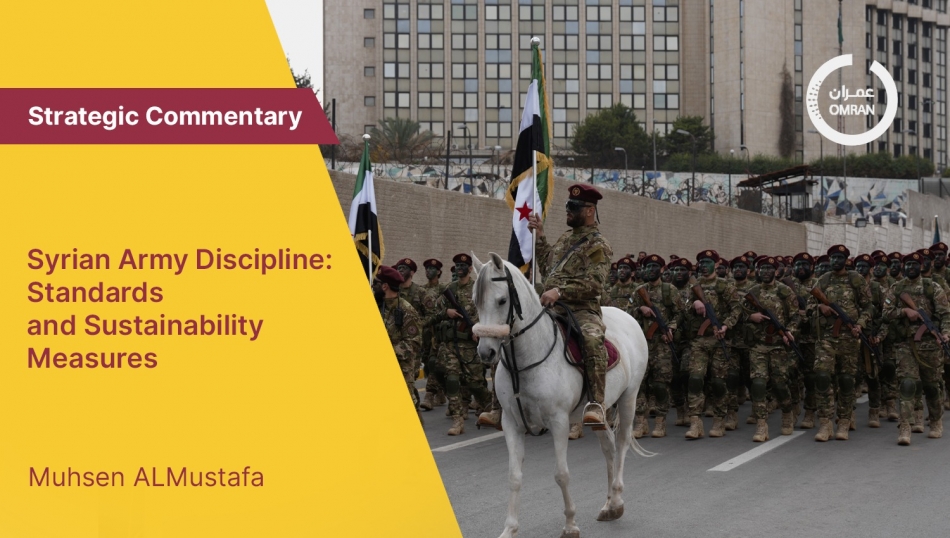
In the Syrian context, the operations that began in Sheikh Maqsoud and Ashrafieh in Aleppo in early 2026 then extended to Deir Hafer and Maskanah, before later connecting with the Tabqa and al-Jazira axes up to Hasakah offered an important indicator of a gradual shift from the use of force to the management of force. This shift was accompanied by a notably high level of discipline and compliance with decisions, directives, and the Ministry of Defense’s Code of Conduct, which was reinforced through the continued circulation of professional and behavioral bulletins to army personnel at all levels, from commanders to rank-and-file soldiers.
This shift stands out as an evolution in civil–military relations as much as it is an evolution in tactics, because success in populated environments is not measured solely by winning the battlefield, but by the institution’s ability to consolidate security without producing a new form of social antagonism.
The Aleppo Test: Fire Discipline to Generate Legitimacy Not Deterrence Alone
The battles of Sheikh Maqsoud and Ashrafieh in Aleppo constituted a practical stress test for a relatively newly formed army undergoing the integration of multiple factions. Operations unfolded inside densely populated neighborhoods against an adversary capable of sheltering among civilians and raising the cost of any miscalculation. This type of urban warfare requires a higher-than-usual level of discipline, since any uncalculated push can turn firepower advantage into a political liability.
Accordingly, the slower pace of execution, the phased nature of the assault, the precise delineation of target areas, the opening of safe corridors, and the management of evacuations in coordination with other state institutions were not marginal details. They were the product of functional and behavioral discipline through which the force was able to neutralize the adversary while insulating the broader community from the battle.
The orderly withdrawal of some SDF fighters or the provision of a legal off-ramp for those who lay down their arms also proved to be an effective strategy for reducing losses, avoiding the expansion of hostility, and pre-empting accusations of retaliation. It can be inferred that the Syrian leadership treated the moral cost as a future security and humanitarian cost as well.
From Deir Hafer to al-Jazira: Managing Geography to Prevent Disorder
The same trend is reinforced by the declaration of Deir Hafer and Maskanah as closed military zones on 13 January 2026. Restricting the area before engagement reduces random friction, facilitates movement control, and turns fighting into a bounded, clearly defined mission. In this sense, delineating the scope of the measure is not merely an administrative step; it is a discipline mechanism that constrains individual discretion, protects supply lines, and builds enforceable accountability because crossing the designated boundaries becomes observable and therefore punishable.
The expansion of operations toward Tabqa and Syria’s al-Jazira region demanded an even higher level of discipline, as the operating environment grows more complex amid overlapping communities, sensitive identities, multiple loyalties, and the accumulated legacies of a war economy.
This compels the army not only to fight, but also to avoid falling into the trap of heavy-handed control an approach that may succeed tactically in the short term yet fail strategically over time. It also appeared that the Arab tribes that revolted against the SDF mirrored the measured conduct they had previously observed during the army’s operations in Sheikh Maqsoud and Ashrafieh, even before the military campaign reached their areas.
Professional Conduct Bulletins: InstitutionalizingDiscipline as an Enforceable Standard
The Ministry of Defense circulated a series of professional conduct bulletins as a regulatory framework designed to strengthen control and enforce discipline.(1) The intent was to establish a behavioral standard that precedes engagement and accompanies it throughout by unifying the logic of combat within a state-centered narrative, restricting movement through the chain of command, protecting civilians and property, regulating the information space, and avoiding language that could inflame local, ethnic, or regional sensitivities.
The chronological sequencing of these bulletins suggests that the Ministry did not merely issue general guidelines but sought to build a live directive system that follows the battlefield step by step particularly during the Hasakah phase, where military operations became intertwined with political understandings, consultation windows, and ceasefire pauses. This, in turn, reinforced a logic of risk management and restraint, constrained the potential for indiscipline, and contained provocative rhetoric that can awaken dormant conflicts. It also helped regulate public messaging, recognizing that an individual mistake can escalate into a national crisis within hours.
The Model’s Limits: Limited Breakdown,Disproportionate Losses
In 2025, Syria witnessed major security episodes on the coast in March 2025 and in Suwayda in July 2025. Recalling these events underscores the need for a realistic, grounded approach: lapses in control at the time did not only harm the victims; they also harmed the state itself by deepening societal fractures, eroding trust, and increasing the cost of governance. This does not imply, however, that other parties to these confrontations refrained from serious violations committed not only against civilians, but also against soldiers and internal security forces.
The conduct of the new military institution suggests a practical rupture with that legacynot merely through reassuring rhetoric, but through behavior that curbs retaliatory impulses and prevents military operations from sliding into an identity-based conflict. That said, instances of non-compliance among some personnel cannot be denied. This is to be expected in an army that is expanding operationally across distant fronts, integrating new recruits, and operating in areas undergoing shifts in control. Crucially, however, such violations are being met with accountability and a judicial process.
Of course, such lapses can become a compounded risk when they are socially interpreted as institutional behavior rather than individual misconduct, and when they are politically instrumentalized to revive fear-based narratives or invite external interventions. This makes it imperative to address violations swiftly and firmly, because delayed accountability functions, in practice, as implicit encouragement and undermines the authority of the law an authority that should be a defining feature of the new army.
This is precisely what the Security Directorate and the Military Police within the Ministry of Defense sought to do by detaining all personnel who failed to comply with previously issued instructions and decisions, foremost among them Decision No. 31 of 2025 issued by the Ministry of Defense.(2)
Conditions for Sustainability: How Can Discipline Be Institutionalized as State Policy?
Consolidating this trajectory requires turning guidance into implementation through four interlinked pillars:
First: activating accountability as an internal deterrent tool through effective field inspections, disciplined documentation, and graduated sanctions that are actually enforced while linking a commander’s responsibility to the conduct of his personnel, not to firepower outcomes alone.
Second: establishing safe, rapid civilian complaint channels connected to the Military Police and local authorities along the lines of the complaints mechanism within the Ministry of Interior on the basis that early response extinguishes the spark before it escalates into a broader grievance.
Third: deepening training programs on rules of engagement, civilian protection, and crowd management, while repeatedly reminding personnel that controlling anger is part of strength, not its opposite.
Fourth: regulating the information and media space within units, because digital disorder often precedes field disorder and because, in fragile environments, a rumor can have the impact of a bullet, or even a bomb.
Conclusion
The discipline demonstrated during the execution of recent military operations represents a strategic opportunity to redefine the relationship between the army and society on the basis of law rather than fear. It must be sustained and carried forward, evolving into an institutional culture in which rhetoric is matched by practice and responsibility, and violations are treated as threats to national security not merely as individual mistakes.
([1])“Professional conduct circulars issued by the Ministry of Defense and examined by the researcher.
([2])“Syrian Ministry of Defense Issues a Package of Decisions to Regulate Military Discipline”, Sham News Network, Publish Date:
August 25, 2025, Link: https://bit.ly/49DSa9o