Events

Rateb
Monthly briefing on the events of the Syrian scene - April 2023
Executive Summary
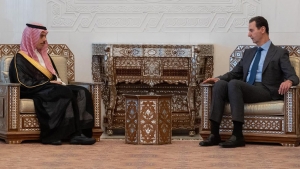
This report provides an overview of the key events in Syria during April, focusing on political, security, and economic developments. One significant political event was the Arab rapprochement with the Assad regime, highlighted by the visit of the Saudi Foreign Minister to Damascus. This visit marked the end of a decade-long official boycott and was accompanied by the exchange of ambassadors between Damascus and Tunisia, as well as the reception of Assad's foreign minister in Egypt and Algeria. Despite these political developments, the shortage of essential goods and high prices remained major problems for the Syrian population. This issue was particularly pronounced during the month of Ramadan and Eid al-Fitr, with prices rising by 100% compared to the previous year. On the security front, there were no significant changes in the Syrian arena. Israeli airstrikes continued to target military and security sites associated with Iranian militias. Additionally, Ankara announced the killing of an ISIS leader.
Arab rapprochement with the Regime: “Swift Progress”
During April, the Syrian political scene revolved around the Arab rapprochement with the Assad regime. This included significant developments such as:
- Tunisia reopening its embassy in Damascus.
- The regime's Foreign Minister, Faisal Miqdad, visiting Egypt and Algeria.
- The Saudi foreign minister's visit to Damascus after a decade-long official boycott.
These visits were part of an Arab diplomatic effort led by Saudi Arabia, Jordan, and the United Arab Emirates to engage with the Assad regime. This engagement came with various Arab demands, including political reforms and the establishment of a safe environment for the return of refugees, but at the same time it became clear, that the Arab rapprochement with the Assad regime lacked a clear roadmap for achieving desired outcomes. The path of reconciliation with Turkey also faced obstacles as the regime insisted on the withdrawal of Turkish forces from Syrian territory as a condition for restoring relations. Ankara, however, refused to include this condition in the current agenda.Meanwhile, key figures within the Opposition maintained their opposition to normalizing relations with Assad. They held meetings with European ambassadors and envoys in Qatar, capitalizing on the Western discourse that emphasizes non-normalization until UN resolutions are implemented.The "Autonomous Administration" focused on sending messages to regional countries aligned with the Assad regime. These messages aim to showcase the administration's ability, as a local Syrian entity, to play influential roles in areas of common interest, such as counterterrorism, preventing drug exports, and facilitating the return of refugees. The messages include the following key points:
- Launching the "Peaceful Resolution to the Syrian Crisis" initiative, urging the "Damascus government" to take urgent actions to expedite a solution.
- The readiness of the forces of the Autonomous Administration to join the Syrian army, as stated by SDF commander Mazloum Abdi.
- The announcement of the Autonomous Administration's preparedness to receive Syrian refugees from Lebanon in coordination with the UN and the EU.
Security incidents: “Limited Impact”
In April, Israel kept on targeting locations with Iranian influence and control. These strikes focused on security and military sites in various regions, including Damascus and its surrounding, al-Suwayda, Daraa, Quneitra, and Homs.Meanwhile, the International Coalition assassinated a prominent ISIS leader, Khaled Eid Ahmed al-Jubouri in Idlib, al-Jabouri is from Iraq, and responsible for planning terrorist attacks in Europe. Turkish intelligence also reported the assassination of another ISIS leader, Abu al-Hussein al-Husseini al-Qurashi, in a military operation conducted in northwestern Syria.Daraa witnessed a series of assassinations resulting in the loss of 32 lives, with an additional 17 individuals losing their lives in separate security incidents. This highlights the ongoing state of security chaos that the Assad regime and its allies have been unable to resolve.
Shortage of basic materials and high prices
In the Regime-controlled areas issue of escalating commodities prices continued to burden the Syrian population, particularly during the month of Ramadan and Eid al-Fitr. Prices surged by 100% compared to the previous year's Ramadan. The situation was compounded by the Syrian pound's depreciation, reaching a rate of 8,250 SYP against the dollar, while the Central Bank's ability to intervene in the market declined. In April, the regime government implemented several decisions, including:
- Increasing prices and fees for transporting materials and goods via trucks.
- The Telecommunications and Post Regulatory Authority (TPRA) raised the fares for cellular services by 30% to 35%, and fixed telecommunications services by 35% to 50%.
- The regime's government set the purchase price of wheat at 2,300 SYP per kilo of wheat. However, the production cost is around 2,050 SYP, resulting in a narrow profit margin of only 150 SYP per kilo for farmers.
The depreciation of the Syrian pound in Autonomous Administration-controlled areas has had repercussions across various sectors. In the electricity sector, generator owners raised the prices of amperes to 8,000 SYP, even though the municipalities of Qamishli and al-Haskalah had set the price at 7,000 SYP per ampere. Additionally, the region is still experiencing a shortage of sugar, which led to a price increase. During this month, the Administration, under Russian supervision, reached an agreement with the regime concerning "drinking water and electricity." As per the agreement, the regime will supply the city of Manbij and its surrounding areas with drinking water from the Babiri station in Khafsa. In return, the Autonomous Administration will provide the regime with 30 megawatts of electricity per day from the Tishreen and Tabqa Dam, along with 50 oil tanks per day. In Opposition-controlled areas, the local council in the city of Azaz demanded a reduction in the price of kilowatts from the electricity company AK ENERGY. The company responded by reducing the value of electricity subscriptions starting from April 10. However, despite this adjustment, people and local councils continued to express their dissatisfaction as the new price remained high and not in line with living conditions. Regarding recovery projects in the region, the Trust Fund for the Reconstruction of Syria announced the delivery of 400 tons of fertilizer to two thousand vegetable farms and 850 tons of fertilizer to two thousand wheat farms.
Regional efforts to mitigate Feb-6 earthquake damage
The Qatar Fund for Development has announced an agreement with the Turkish Presidency of Disaster and Emergency Management (AFAD) to support the establishment of an integrated city in northern Syria. This city aims to accommodate 70,000 people. Additionally, the Qatar Development Organization and the United States Agency for International Development have signed a funding agreement to support the Syrian Civil Defense Organization's essential operations. The "salvation" government in Idlib has reduced the price of domestic gas cylinders by 90 cents (around 17 Turkish liras), bringing it down from $13.5 to $12.6. Idlib National Hospital is also planning to distribute free medicines intended for cancer patients. The conditions for cancer patients in northwestern Syria have worsened as Turkish hospitals stopped receiving them after the earthquake disaster on February 6. The Syrian Response Coordinators/ منسقو استجابة سوريةteam has issued the final report on the damage caused by the February 6 earthquake in Syria and Turkey. The report reveals that:
- Over 1.8 million people were affected in northwestern Syria, with 4,256 civilian casualties, around 12,000 injured, and 67 individuals still missing.
- The number of displaced people has reached 300,000, with more than 65% of them being children, women, and individuals with special needs.
- Economic losses from the earthquake are estimated at $1.95 billion, including damage to public and private sectors and other facilities.
- The earthquake also caused significant damage to educational institutions (433 schools), medical facilities (73), and housing units (136).
An Assessment of Earthquake Response by Civilian Actors in Syrian Regime-Controlled Areas
Introduction
Following the devastating earthquake that struck cities in southern Turkey and northern Syria on February 6th, 2023, the civil society in Syria has mobilized in both areas. This included regions under the control of the Syrian regime as well as Northwest Syria, which is under the Opposition's control.
In previous years, the civil society in areas controlled by the Opposition has been responsible for addressing urgent needs arising from various crises, such as winter campaigns, post-shelling recovery efforts, and other emergencies. However, in areas under the Syrian regime's control, the concept of "Emergency Response" is a relatively new development.
The purpose of this paper is to examine the response by civil society organizations to the recent earthquake in areas under the Syrian regime's control. It will investigate the level of support provided by the regime, as well as the goals of civil society response. This will involve monitoring and assessing the activities of various institutions and categorizing them based on their seniority, the type of work they do, and their geographic coverage. Additionally, the study will better dissect the role of the "Syrian Trust for Development"(1) rthrough their response(2)
Other Fronts of The Syrian Trust for Development (STD)
The Syrian Trust for Development (STD) was established in 2007 to coordinate civil society efforts in Syria and promote them to the international community. Following the February 6, 2023 earthquake, the organization has sought to redefine its role both internally and externally, partnering with several external entities to support local initiatives and organizations.
Even though STD is overseen by Asma al-Assad, it was able to form partnerships with prominent organizations such as the Norwegian Refugee Council(3) . and UNESCO(4)but it has been unable to generate substantial income for the regime from humanitarian aid funding, as the grants provided by the United Nations did not exceed $6 million during the years 2016-2017-2018.(5).
Activating (STD) became increasingly necessary after 2019, when the Caesar sanctions and successive Western sanctions against Syrian regime officials created financial urgency, so STD tried to become a back door to critical financial needs reflected by the earthquake disaster based on the civil actors that were active in the areas controlled by the Syrian regime.
The entities that participated in the emergency response have been categorized into unions, licensed organizations, Syrian initiatives created in response to the disaster, non-Syrian organizations and initiatives, and organizations affiliated with STD. There were around 134 Syrian and non-Syrian civil entities involved in the emergency response, and this estimate does not include official or foreign government delegations that visited the Syrian regime or provided direct aid to regime airports.
As shown in Figure (1), more than 45% of the organizations (Syrian and foreign) that participated in the earthquake response are linked to (STD) through a partnership or affiliation(6).At the same time, a good number of volunteers were mobilized to respond without being fully regulated by the regime, like its behavior with some religious groups in Damascus between 2006 and 2009, in order to ease the burden of relief work on it after failing to meet the relief needs of the poor classes in the capital.(7)
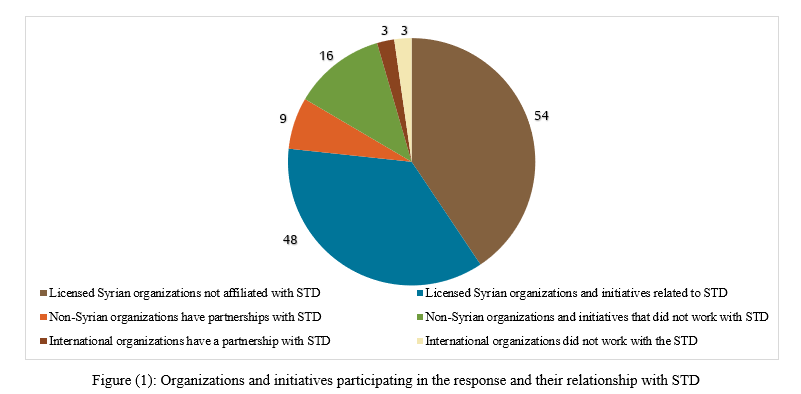
On the other hand, STD did not receive any direct support from international organizations or non-Syrian government support. Instead, STD collaborated with non-Syrian to provide aid. The organization also made efforts to publicize the delegations and international or civil aid they provided to earthquake victims(8) However, foreign organizations ignored STD on their media pages, Such as the Pakistani humanitarian organization and the Emirati Red Crescent.(9)
The Response and Its Quality
The earthquake struck several Syrian provinces, including Aleppo, Hama, Idlib, Tartous, and Latakia, with their countryside. The "Supreme Relief Committee" in the regime's government announced that:
- The number of affected families due to the earthquake reached 91,794.
- The number of buildings unsuitable for living reached 4,444 buildings, and 29,000 buildings can be used but require major reinforcements.
- The number of buildings suitable for use but need maintenance reached 30,000.
The number of buildings that got demolished due to their exposure to collapse reached 292., the number of deaths due to the earthquake reached 1,414 and 2,357 injuries.(10)
On March 3rd, 2023, the World Bank released a report estimating the material losses from the earthquake that struck four Syrian provinces at around 5.1 billion US dollars. However, Bashar al-Assad claimed that 50 billion US dollars were required to rehabilitate the affected areas (11) and that was a clear indication of the regime's exploitation of the earthquake disaster in order to benefit from the exemption from the US and Western sanctions relief that was issued after the earthquake.
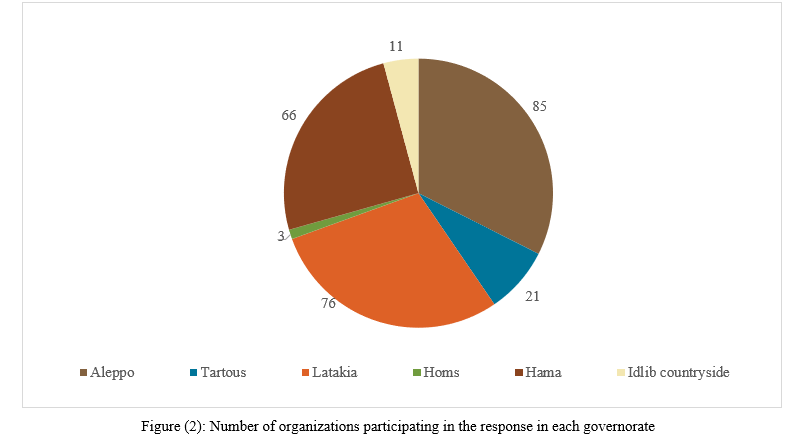
During this period, civil society actors’ response to the earthquake varied in each province, as seen in Figure (2), which displays the number of organizations operating in each affected province under the control of the Syrian regime. Aleppo had 85 organizations, Latakia had 76, and Hama had 66. Most participating organizations in the emergency response were based in Damascus.
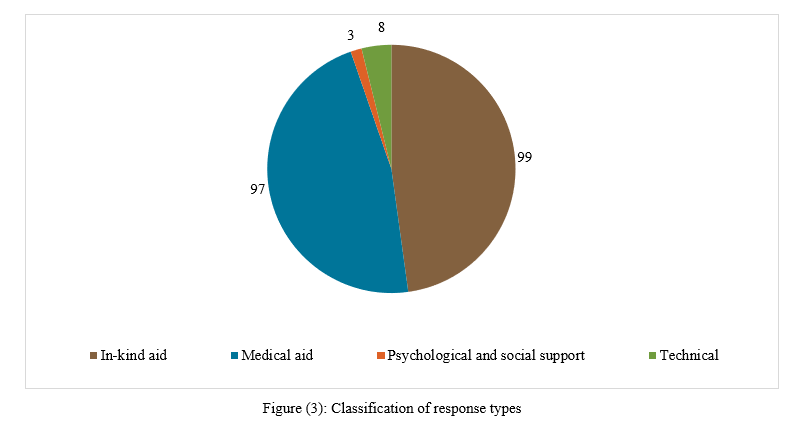
The entities engaged in the emergency response operate within different sectors, as shown in Figure (3), and many work in more than one sector. However, the variation in size of relief efforts delivere combined with the lack of ability to evaluate its volume due to the absence of reports from civil organizations about their work, number of beneficiaries, and selection mechanisms, is an indicator of weak transparency standards, making it impossible to assess the amount of aid provided and its impact.
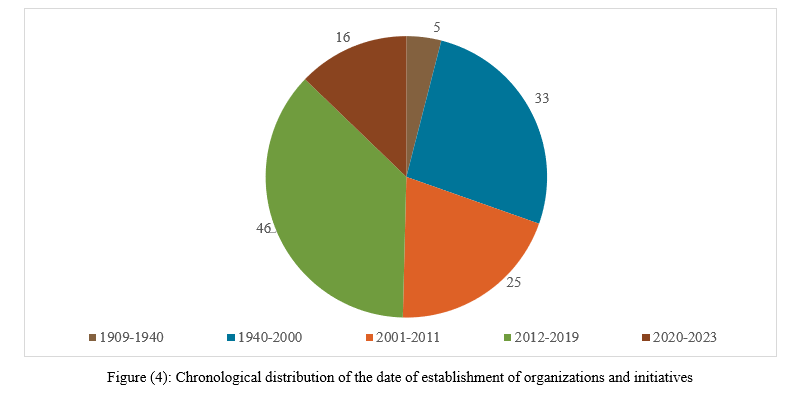
The Syrian regime aimed to promote the image of civil society in areas under its control in an attempt to create alternative operational mechanisms for its official institutions, which were subject to sanctions from US and/or EU, or for some of the companies that funded them and surfaced after the outbreak of the Syrian uprising.Figure (4) displays the establishment dates of organizations and initiatives that participated in the recent emergency response. “The number of organizations and initiatives founded after 2011 is twice that of those established since the Ba'ath party took power in 1963.”
Although civil society activities and areas of operations, seems to have expanded in areas controlled by the Syrian Regime, it has not been successful in establishing significant partnerships across different affected areas by the earthquake in Syria, for several reasons, such as:
- Systematic flaws in the laws regulating civil society organizations.
- The regime's security philosophy, which restricts and monitors the work of many organizations seeking to align themselves with STD.
Despite the challenges faced by civil society in areas under the control of the Syrian Regime, they have managed to establish a few limited partnerships, primarily through the efforts of STD.
Conclusion
In summary, there has been a notable increase in the number of civil society actors, both Syrian and non-Syrian, responding to the earthquake in areas controlled by the regime. However, there is a lack of accurate data regarding the extent of their work, funding, outcomes, and challenges. Additionally, most organizations have not published reports detailing their activities, which has led to skepticism about the authenticity of the media coverage.
While civil society engagement is crucial in responding to humanitarian crises, the regulatory framework governing civil action, coupled with the regime's security-focused approach, meant that civil actors’ engagement is constantly scrutinized. Furthermore, the lack of clear coordination and integration methods, oversight mechanisms, and transparency has played into the regime's hands, especially concerning the Syrian Trust for Development, which it views as a politically exploitable tool. Despite the regime's attempts to showcase the effectiveness of civil society organizations in its regions to attract international support, no such support has materialized yet.
([1]) The Syrian Trust for Development (STD) is a non-profit organization based in Damascus, Syria. It was established in 2007 and is owned by Asma al-Assad. The stated goal of its founding was to promote sustainable development in Syria by providing financial grants and other forms of assistance for projects that support economic growth and improve the quality of life for Syrians. It became a major player after 2011.
(2)The survey was conducted based on the identifiers of organizations, initiatives, and unions, in addition to the pages STD, where a full table was prepared of 134 entities that participated in the emergency response to the earthquake, in addition to the spread of these associations, their work sectors, and their association with STD based on previous implemented projects.
(3) STD Facebook page 02/03/2023 https://bit.ly/3FwJvWH
(4)Prime Ministry website, the Syrian Trust for Development is an organization accredited by UNESCO for the next four years 12/22/2021 https://bit.ly/3YVQqiY
(5)The role of charitable work in the Syrian war: Non-governmental organizations sponsored by the regime and charities affiliated with armed groups, Robert Schuman Center for Postgraduate Studies at the European University Institute, Ayman al-Dasouki and Sinan Hatahet 07/06/2020 https://bit.ly/3LB0Amt
(6)Affiliation means the presence of the following indicators: 1- Exclusive financing by the Secretariat 2- Direct supervision.
(7)The Limits of “Authoritarian Modernization” in Syria: Private Social Security, Islamic Charities, and the Rise of the Zayd Group, International Journal of Middle Eastern Studies, Thomas Perret and Ketel Silvik, Issue 41 (2009) https://bit.ly/3mQavtO
(8) STD Facebook page about its partnerships with the Pakistani Humanitarian Organization 03/03/2023 https://bit.ly/3kM8pL1
(9)Look at the following:
- The Facebook page of the Pakistan Humanitarian Organization 03/03/2023 https://bit.ly/3JOKWma
- Emirates Red Crescent Facebook page 02/18/2023, https://bit.ly/3JuNsN1
(10)Deeb Sarhan: “What is the final outcome of the devastating earthquake in Syria?”, Qasioun, 3/4/2023, https://2u.pw/QHlhB2
(11) Al-Assad estimates the earthquake’s damage ten times the estimates of the “World Bank,” Enab Baladi, 3/16/2023, https://2u.pw/6Yeyc4
Statement Solidarity to Counter Repercussions of the Earthquake in Syria
10- February- 2023
The earthquake that struck southern Turkey, and northern and western Syria caused heavy casualties, exceeding thousands of dead and missing, and hundreds of thousands of displaced people, with massive destruction of infrastructure and deterioration of basic living conditions. This new shocking catastrophe exacerbated the suffering of all Syrian men and women, residents, internally displaced, or refugees, in a war-torn country that has been politically and socially fragmented and controlled by various military and security forces and dominated by conflict economies. It has become clear that the warring actors cannot meet the protracted challenges caused by the 12 years of the conflict, or cope with the earthquake's immeasurable effects. Those actors will generate further injustice and exclusion and increase the suffering of both those affected and survivors of the earthquake.
The Societal Role: Syrians have shown a high level of solidarity since the first hours of the disaster; they joined forces at home and abroad, expressing their unity in the face of the tragedies associated with the earthquake. Syrians, women and men, are in dire need of solidarity in the face of the earthquake and its direct and indirect ramifications through joint action in order to help those affected, identify priorities and options for intervention and mitigate the effects of the disaster. The priority is to coordinate and respond to reach the most affected individuals and communities and save their lives before it is too late.
Overcoming Conflict’s Polarizations: Efforts have been already made to create solidarity between civil institutions and community initiatives working in the civic space, they aim to open a new space for Syrian solidarity action, which is an urgent need to identify the sufferings and needs of Syrians, overcome the damage and help those affected, improve the effectiveness of interventions, share experiences and resources, and enhance the role of society in the potential interventions. Strengthening cross-division solidarity and overcoming political, regional, ethnic, religious, gender and other divisions that have deepened during the conflict require mobilizing the human, material and institutional resources in all regions through joint action to mitigate the damage and overcome the divisions of the conflict. Solidarity requires the advancement of civic action towards transparent and effective governance and accountability, a commitment to the ethics and principles of humanitarian work, human rights, dignity and freedoms, and an emphasis on justice and participation at all stages of activity.
The Humanitarian-Development-Response: In order to overcome the gaps and challenges associated with the relief response, it is necessary that the Syrian society takes the initiative in leading and organizing the response, producing evidence and field studies to underpin urgent interventions and make them available to all. It is also necessary to coordinate between the local communities, civic initiatives and research centres. In addition, it is essential to link relief interventions with development alternatives, as well as linking humanitarian interventions with dismantling the conflict causes and mechanisms to ensure that the effects of the disaster are overcome in a sustainable manner.
Effective International Solidarity: Despite the remarkable solidarity and cooperation of individuals and institutions at the international level, confronting the disaster requires a different role from the UN and international institutions. Humanitarian aid is insufficient without a safe space for work, fair access for all, and breaking the restrictions imposed by political and military forces. International support is crucial to overcome the catastrophe provided that the Syrian society is given a space to take the initiative in managing interventions -while focusing on commitment to interventions that are centered on the rights and freedoms of Syrians- and confronting the narrow political interests of the conflict forces by lifting restrictions on mobility and providing human and material aid across borders and regions.
Exerting Pressure on the Warring Parties: Pressure should be exerted on political and military local, regional and international forces to open internal and external conflict lines for humanitarian/development activity, to redirect military and security spending to confronting the disaster, to stop levying royalties, pillage, monopoly, and encroachment on aid and civil organizations and initiatives. The civil actors need to work and advocate to redistribute energy derivatives, food, housing, and decent living conditions to those affected by the disaster, and to put an end to hate speech and political exploitation of the suffering of Syrians.
This statement is a call for solidarity to overcome the ramifications of the catastrophic earthquake and dynamics of the Syrian war.
Signatory organizations Syrian Centre for Policy Research (SCPR) – OMRAN Center for Strategic Studies - Basmeh & Zeitooneh - Hand in Hand for Relief and Development - Baytna Syria - Multi Aid Programs (MAPs) - Ettijahat- Independent Culture - Musawa: Women’s Study Center for Equality - Local Development and Small Project Support (LDSPS).
The Syrian Regime Signals Legal and Military Shifts to the World
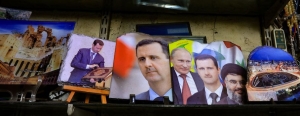
Since mid-2021, the Syrian regime has introduced a set of new policies targeting a number of vital sectors. These policies can be mostly observed in the legal and legislative sector, as well as with new appointments in the security and military fields—Syria’s most thriving branch ever since 2011. These changes, which have been kickstarted after the latest presidential elections in May 2021 and the formation of a new government in August, have been part of the regime’s new push to end its international isolation, while military operations were reduced to the minimum.
Legislative changes
The new laws introduced over the last year represent the regime’s attempts to get closer to the appearance of a modern state. It aims to facilitate a comeback to the international community by addressing matters it had ignored in the past years. Changes in legislations are listed chronologically as follows:
The Child Protection Act, Law No. (21) of 2021, issued in August, is the first of its kind in Syria. This law, according to the regime, aims to promote the state’s role—in both public and private institutions—in protecting children, providing care, and ensuring scientific, cultural, psychological, and social rehabilitation of all children.
By introducing this law, the regime tried to portray itself as the protector of children and their rights. According to this text, children are granted the right to education, and any child under 15 is prohibited from working. The law bans the use of children in media or publicity in a way that infringes their privacy. Additionally, children are not to be affiliated with political parties. The legal age for marriage is also fixed at 18.
The law outlaws recruiting or involving children in armed conflicts and any other related activities. In both criminal and civil terms, children cannot be held responsible for committing criminal acts; instead, they are considered victims in the eyes of this law. Children must also be protected from trafficking.
According to the law, the Syrian state has the duty to ensure necessary measures to grant children all their rights. However, there is a great disparity between statements made by the regime and the reality on the ground. A United Nations report states that in 2021, 46 children had been recruited and taken advantage of by pro-government militias. In addition, in 2021 as well, there were 48 recorded cases of children imprisoned by government forces, and 301 killed by Syrian government forces in opposition-held areas. This is without counting the 22,941 children killed by regime forces between 2011 and March 2022. Moreover, 6,358 children are still detained or forcibly disappeared in regime prisons.
The presidential decree abolishing the position of Grand Mufti of the Republic: In November 2021, Bashar al-Assad issued Legislative Decree No. (28) to strengthen the Council of Islamic Jurisprudence and expand its competencies. The decree amended articles of Law No. (31) of 2018 which regulated the work of the ministry of religious endowments and abolished the positions of Grand Mufti of the Republic and the governorates’ local muftis.
With this decree, the Grand Mufti’s role is no longer the purview of one person. It has instead become the duty of the Council on Islamic Jurisprudence, headed by the minister of religious endowments and composed of 44 members representing all Muslim sects and the country’s Christian communities.
This decree is undoubtedly a shift in the regime’s religious policy and deprives Sunnis from a mufti position, implicitly annulling their majority. “This shift does not suggest that Assad’s regime is giving up its harsh centralized grip or embarking on a new secular approach. The regime is rather adapting to challenges generated by the Syrian revolution. It is trying to keep up with a transforming religious elite and its relation with the general public. What can be observed here is an attempt by the regime to tackle the crisis in a different way.”
This decree incorporates members of the Shia community to the jurisprudence domain, a step signaling closer ties to Iran. With this decree, Iran has been ensured a formal access to the Syrian religious sphere.
Anti-Torture Act: Law No. (16) of 2022 was passed in March and criminalizes torture in few articles and brief details. Sentences for those found guilty of torture range from three years of imprisonment up to the death penalty. Life sentence is applied in cases involving torture against a child or a person with a disability, or when causing permanent impairment to the victim.
This law has no precedence in Syria, which marks a change, at least in theory. Nonetheless, it contains important gaps and its exact application remains unclear. For instance, members of the armed forces who are accused of torture are not mentioned by the law. Resting on their impunity, it is prohibited to file a lawsuit against them without the permission of the armed forces’s general command. The same applies to members of agencies such as General Intelligence, as well as the Political Security Unit and the Internal Security Forces—both linked to the Ministry of Interior. Similarly, members of the Customs Department, an organ of the Ministry of Finance, enjoy the same level of impunity.
In addition, the law does not specify any regulatory frameworks: it falls short of naming entities and spaces that will be scrutinized. For instance, it does not cover prisons, where ten thousand prisoners were, and still are, tortured.
It is no coincidence that this law has been issued after the Caesar Report was released, documenting systematic torture and killings inside regime-run prisons. At least 14,449 detainees—including 174 children and 74 women—were documented to have gotten murdered by the Syrian regime forces in prisons between 2011 and March 2022, with no legal consequences.
Penal Code: In March 2022, Law No. (15) was passed, introducing amendments to the Syrian Penal Code. The new law eliminates permanent and temporary hard labor penalties, stipulated in all other legislations, and replaces them with prison time or a life sentence. Another amendment raises the fines for crimes, ranging between 25,000 to 6 million Syrian pounds ($25 – $1,185), depending on the nature of crime.
The new law also modified Articles 285 and 286 of the Penal Code, punishing those who “infringe the national identity or provoke racial and sectarian strife” with temporary imprisonment. The same applies for anyone who disseminates “fake or exaggerated news to create a sense of despair or insecurity within the society.” Syrians who call for dividing or conceding sovereign territories—in any written or verbal form—face at least one year of imprisonment.
The Syrian regime has repeatedly resorted to both articles, particularly Article 285 which criminalizes those who “weaken national sentiment.” These articles have become the fundamental legal basis for bringing charges against protestors who have taken part in the revolutionary movement since 2011. All of those incarcerated by the Syrian regime face outright arbitrary charges. Every time an amnesty decree is issued, these two provisions were incorporated while other articles were excluded.
Cybercrime Law: The Cybercrime Law No. (20) of 2022 was passed in April and was presented as an alternative to the 2012 law combating cybercrimes. The new law raised the number of penal offenses from nine to 21.
The law mainly expands privacy-related crimes and extends prison terms. The 2022 law raises the amount of financial penalties, taking into consideration the depreciation of the Syrian currency. For example, in cases of unauthorized access or use of data, the 2012 law stipulated a sentence of 3 months to 2 years, which turned into 1 to 3 years with the new law. Equally, fines were raised from 100,000 – 500,000 Syrian pounds ($20 – $100) to 700,000 – 1 million Syrian pounds ($140 – $200). In addition, the law added more penal offenses to crimes related to the constitution and undermining the state’s prestige or financial situation.
After passing the law, the Ministry of Interior started restructuring and rebuilding the Cybercrime Combating Branch Unit and announced that a number of people were detained on various charges under the 2022 law.
The way the law has been applied in Syria is alarming. The regime has used it as an additional tool to silence Syrians who live in regime-controlled areas and to prosecute those who fled. In other words, the regime has succeeded in re-legitimizing the state of emergency in a new and implicit fashion.
Amnesty Decrees: In January 2022, Assad issued Legislative Decree No. (3), granting a general amnesty for those who have deserted, whether volunteers or those who were completing their compulsory military service. For those who deserted domestically, they must turn themselves in within three months, and those abroad must surrender themselves in four months, at the latest.
This decree was meant to facilitate new security settlements in the regions of Raqqa, Deir Ezzor, Aleppo, and the Damascus countryside, so that the regime can benefit from those who had previously defected from the army and have them return to service. At the same time, the regime wanted to send a message to military rebels abroad, especially those in Turkey, following the closure of a camp in the Turkish province of Hatay.
In April 2022, Assad passed Legislative Decree No. (7), which grants general amnesty for “terrorism-related crimes’” that did not cause any death, as stipulated in the Counter-terrorism Law and the Penal Code and its amendments. At the beginning, the decree drew regional and international attention, however, loopholes were soon detected, which allowed the regime to carry on with the criminal policy it had been pursuing against the Syrian people since 2011.
Since 2011, there have been 23 amnesty decrees, and yet, there are still about 132,000 detainees inside the regime prisons. Only 539 prisoners were released after the latest amnesty decree, all the while 300 individuals were arrested by regime forces between May and August 2022—28 of whom were later set free.
The Assad regime has been using these new legislations to put an end to its isolation imposed by the international community since 2011. The Syrian regime had depended on Russia in the past to break its isolation in the international scene, but it can no longer do so, as Russia has become even more isolated than Syria following its war in Ukraine. The legislative efforts observed in the past year have been issued alongside other noteworthy appointments and changes in the military and security fields.
The new era of appointments
There have been some notable changes in some of the appointments in the military and security fields. On April 28, 2022, Assad appointed Major General Ali Mahmoud Abbas, a Sunni from the Damascus countryside, as the new Minister of Defense. His predecessor was Ali Abdullah Ayoub, an Alawite who has occupied this position since early 2018.
Two days after this announcement, Assad appointed on April 30 artillery officer Major General Abdul Karim Ibrahim, an Alawi from Tartous, as Chief of General Staff of the Army and Armed Forces. This position had been left vacant for four years, since early 2018, and was mandated by the Russian operations center in Damascus. Giving this post back to a Syrian official was viewed as the Syrian regime reclaiming the office away from Russia, busy with its war in Ukraine.
These new appointments were controversially received and analyzed. Indeed, they mark a change from previous military hierarchical traditions in Syria: in the past, these top positions were filled by officers with higher ranks—Lieutenant Generals, not Major Generals. The newly-appointed officials were not among the oldest officers with this rank, and this once again was at odds with the military hierarchical order, applied in the Syrian army. It was only after their appointment that both Abbas and Ibrahim were promoted to the rank of Lieutenant General. The number of Lieutenant Generals in the army does not exceed 25, when there are thousands of Major Generals. Yet, being promoted to the rank of Major General is considered a source of pride and reflects close connections with the regime. The decisive criterion for promotion is primarily determined by the degree of loyalty to the leadership, irrespective of professional performance.
There has been no violation to the Military Service Law with these appointments. The rule is that Major Generals decide by free choice who is to be promoted to Lieutenant General. The authority to assign senior posts lies in the hands of “the President of the Republic” and “is enforced by decree and informed by proposal from the Commander in Chief,” both positions held by Assad himself.
These appointments broke a set of military norms, partially because both the current Minister of Defense and Chief of General Staff had never led military operations within the framework of combat units, such as commanding divisions or corps. The Chief of Staff position had been traditionally controlled by someone specialized in ground forces or tanks, not artillery, as in the case of Lieutenant General Ibrahim. Moreover, choosing a Sunni defense minister disrupts—albeit on a limited scale—the Alawi sect’s domination inside the military institution. A study published in 2020 indicated that the 40 most senior military and security officeholders in Syria were Alawis.
Minister of Defense Lieutenant General Ali Abbas served for a long period as a trainer at the Armored Corps College and the High Military Academy. He attended military training abroad, in Pakistan, Sweden, the Netherlands, and Great Britain. The most noteworthy of these training programs was one on reforming the security sector in post-conflict countries, which he attended in the United Kingdom in 2006.
A few days after these appointments, the Assad regime’s tactic became clearer. Neither the Minister of Defense nor the Chief of Staff had been targeted by western sanctions, unlike their predecessors. They are not well known among Syrians, and have yet to be associated with war crimes. Furthermore, the military training courses in Western countries that the minister of defense had taken part to are not common among the military leadership, considering that most take part in military training in Russia and China.
As for the security sector, there have been some changes and promotions at the senior leadership levels in the country’s security services. For instance, this March, a number of intelligence service officers were reassigned, and in early July 2022, others were promoted to higher ranks and positions.
Several security services leaders and officers have been cast aside, while others were promoted and are now the new faces of these agencies with more changes expected: there are speculations that the directors of the Military, Air Force, as well as General Intelligence services are to be replaced in the next few months. The head of the Political Security Division will probably be reassigned to command the General Intelligence Directorate.
Addressing the lower levels in the military hierarchy, Assad issued an administrative order ending the retention and recall of officers and reserve officer candidates enrolled in the compulsory military service. Enlisted officers and officer candidates, who are enrolled in compulsory service are to be demobilized, and non-commissioned officers and reserve personnel must not be retained or recalled anymore. The objective of these decisions is to encourage university graduates, such as doctors and engineers, to stay in their country. Ultimately, the regime seeks to decelerate the very costly waves of migration.
Cosmetic restructuring for the international community
Lately, the Syrian regime has passed an array of legislations to convey the message that it was adopting new policies in compliance with human rights. In the same vein, the regime has organized training courses on international humanitarian law for defense ministry officers. In parallel, government officials have made recurring announcements highlighting Syria’s role as a pioneer in this field, by showcasing capacity-building and awareness-raising activities. The apparent discrepancy between those announcements and the latest policies, and what is really happening on the ground, is astounding. Some of the adopted laws are compatible with the international standards on the surface but when examined closely, it becomes evident that they merely serve as cover-up for the regime’s past and current actions.
In the military and security sector, the regime is trying to initiate a tactical restructuring of upper echelons of its leadership before gradually tackling the more junior levels in the chain of commands. The latest appointments put forward new officers, portrayed by the regime as devoid of guilt and untainted by the blood of the Syrian people. It is expected that, in the next few months, a series of changes will be carried out that will impact key positions in the military institution, and possibly laws, as the regime seeks to achieve more conformity with its actual policies.
The regime has embarked on restructuring the entire state over the post-war phase, despite the war not having ended yet. New policies will cover a larger spectrum of vital sectors. The Russian and Iranian allies are expected to be granted a share, their interests and goals will be taken into account in exchange for securing the continuation of their services to the regime.
Simultaneously, the regime aims to ease the pressure on two issues—refugees and sanctions—with the international community, and is hoping to benefit from setting the country on the path to reconstruction to help support its crumbling economy.
What the Assad regime has been showcasing this past year is that it wants to propose and lead cosmetic reforms, while excluding meaningful political change, expecting to be treated like a victor. The regime seems to be completely convinced that these policies will wipe away its years of destruction and bloodshed and will restore its image to the world. The regime would like the world forget that it used heavy and internationally-prohibited weapons, torture, blockade, and starvation against its own people.
The international community and concerned countries must assume the responsibility of holding the regime accountable to binding international resolutions and enforcing a political solution, which establishes civil peace and instates transitional justice. They have to be reminded that the fundamental dilemma in Syria is not a matter of laws or institutions. The dilemma lies inherently in the ruling regime, which manipulates the state for its self-interest.
Dynamics in YPG-Regime Relations
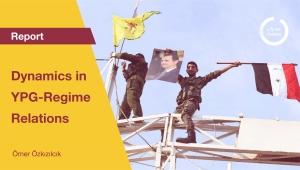
While facing a potential new military operation by the Turkish Armed Forces and the Syrian National Army (SNA) in northern Syria, the general commander of the YPG-dominated Syrian Democratic Forces (SDF) stated in his interview with Asharq al-Awsat:
“We are not opposed to the SDF becoming part of the defense organization of the Syrian army. We have conditions, however. We boast over 100,000 fighters, who have spent the past ten years in combat. They need a constitutional and legal resolution. The SDF must have a role and specific distinction in the military. We are in agreement over general issues, but the problems lie in the details.”
He also stated; “I want dispatch a delegation and go to Damscus when the conditions fora solution are available. I want my trip to Damascus to help in reaching a peaceful solution to the current crisis. ”This statement outlines the current relationship between the Assad regime and the YPG. To understand this relationship and how a potentially new military operation may impact it, this report explores the dynamics of the relationship with focusing on the main dynamics that are related to a Turkish-Syrian military operation.
The first dynamic in the YPG-regime relationship is the concept of a common enemy. For both actors, Turkey and the Syrian opposition are perceived as enemies. However, the YPG’s and the regime’s perspectives oppose one another. The YPG perceives Turkey as an existential threat and sees the Syrian opposition as an actor that enables and facilitates Turkish military operations against the YPG. The Assad regime perceives the Syrian opposition as an existential threat and Turkey as an actor that enables the continuing presence and territorial control of the Syrian opposition. But, since 2016 during Operation Euphrates Shield, there was growing cooperation between the YPG and the Assad regime. Both YPG and the regime forces worked together against Turkey and the current situation resulting in YPG-regime signing an agreement in 2019. During this time, the Assad regime protected the YPG along the frontlines with the Turkish Armed Forces and SNA. Furthermore, in the past, the Assad regime handed over predominantly Kurdish territories to YPG as part of their cooperation in capturing Tal Rifaat and their joint fighting to besiege Aleppo city.
In looking at the second dynamic, the American military presence in Syria negatively influenced the YPG-regime relationship due to their support for the YPG. The US enabled the YPG to control vast territories and altered the balance of power between these two actors. The Assad regime and its supporters, including Iran and Russia did not want the US to remain in Syria. Moreover, there is a difference in ideology between the old and new generations within the PKK – the YPG’s main branch – as it relates to its international relationships. While the old generation values historic partners like the Assad regime, the new generation places its trust in its partnership with the US.
Interdependency is the last main dynamic in the YPG-regime relationship. The YPG and the Assad regime both have territorial control that relies on one another to cooperate. For example, the regime's territorial control in Qamishli and Hasakah is surrounded by the YPG and requires YPG cooperation. Similarly, YPG’s presence in Tal Rifaat and the Shaikh Maqsoud neighborhood in Aleppo city is dependent on the cooperation and protection of the regime that surrounds those areas. Since 2019, the Assad regime deployed army soldiers to the frontlines alongside the Turkish Armed Forces and SNA to function as protection to and from the YPG. This is due to the regime units being located in areas that are far away from regime-held territories where if a war broke out or the regime decided to withdraw their forces, then the YPG could have the ability to target and eliminate these units before the possibility of support arrives. Thus, this delineates the interdependency these two parties have with each other with the regime’s ability to provide YPG with the protection requested while also ensuring their weak points are exposed to minimal dangers.
In looking at the prospects of the YPG-regime relationship, the Assad regime has stated that it wants to go back to how things were in 2010, but with a ‘controllable population.’ It would require the regime to either assert full authority or accept some level of autonomy under the Russian reconciliation agreement model. On the other hand, the PKK’s new generation wants to establish an autonomous region in Syria and achieve international legitimacy via the US with the possibility of engaging in deals on the behalf of Syrian between the US and Russia. With that, the old generation believes that going through Damascus could result in international legitimacy, and would be more realistic as they would gain more legal standing and recognition on a local/national level.
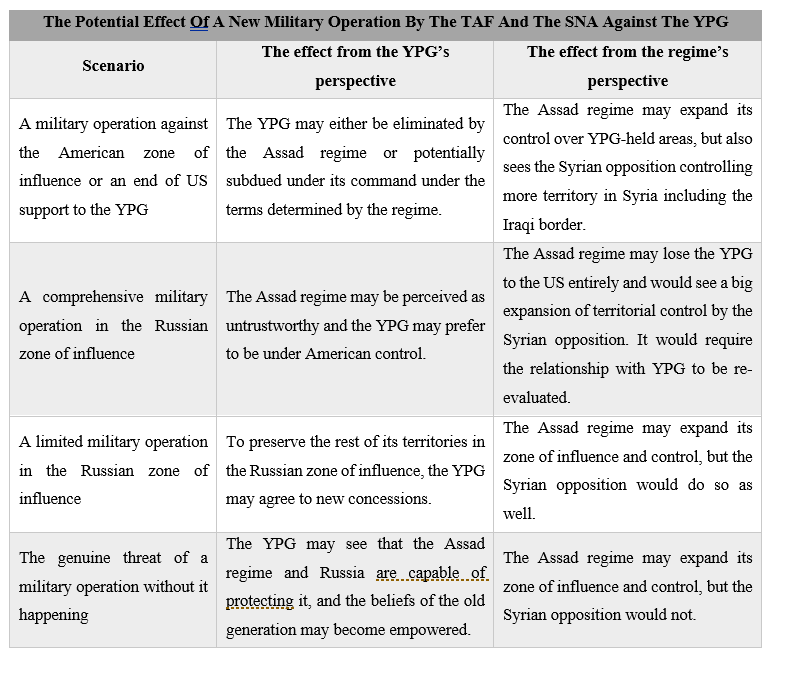
Based on this examination, the report provides four different options for a Turkish-Syrian military operation against the YPG that may alter the YPG-regime relationship: